
Schedule Health Check Software for Microsoft Project
Make Schedules Better.
Run the DCMA 14-Point Assessment, 17 DECM schedule metrics and over 150 more health checks, over 200 metrics in all, inside Microsoft Project, and fix what they find before anyone else sees your schedule.
Schedule Analyzer forProject is an add-in for Microsoft Project. Analyze the schedule, find and fix the issues, then use the built-in exporters to deliver it to your customer as the IPMDAR Schedule Performance Dataset (JSON) or IPMR Format 6 (UN/CEFACT XML).
Works with any version of Microsoft Project that Microsoft currently supports
Sound familiar?
- Schedule problems turn up late, when your customer or DCMA reviews the schedule.
- Checking the schedule means working through filters and spreadsheets by hand.
- Without a good automated tool that runs right inside Microsoft Project, every review takes time you don’t have.
- Your results don’t line up with the way reviewers calculate them.
Schedule Analyzer forProject was built to fix these.
DCMA 14-Point Assessment software and more: what it checks
Government metrics and industry best practice, all in one analysis. See all 200+ metrics.
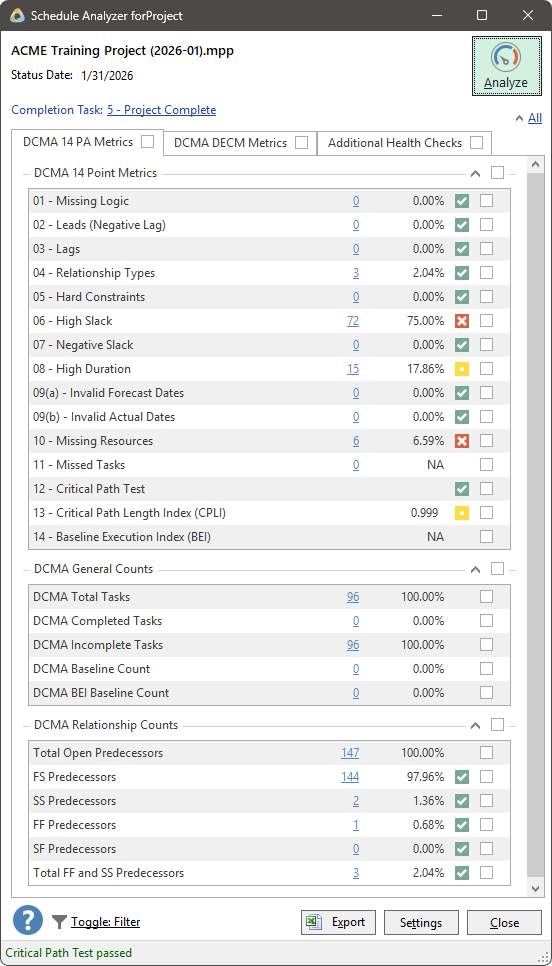
DCMA 14-Point Assessment
All 14 metrics, from Missing Logic to the Baseline Execution Index, with default thresholds based on DCMA’s guidance. See the DCMA 14-Point Assessment checklist or what the assessment is.
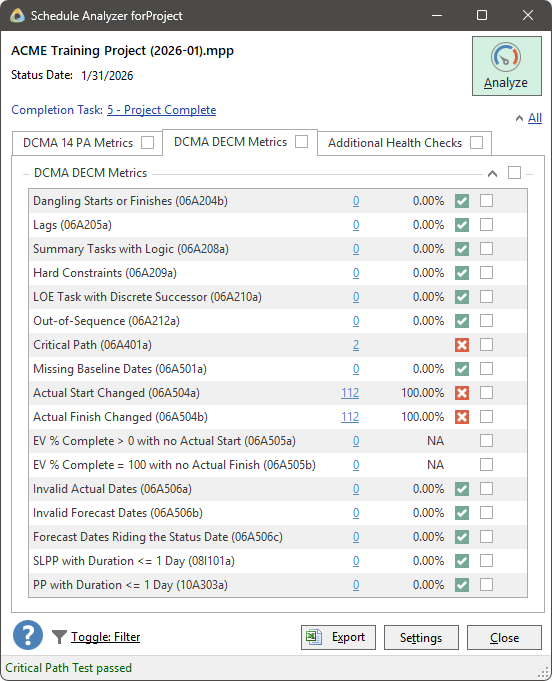
DECM schedule metrics
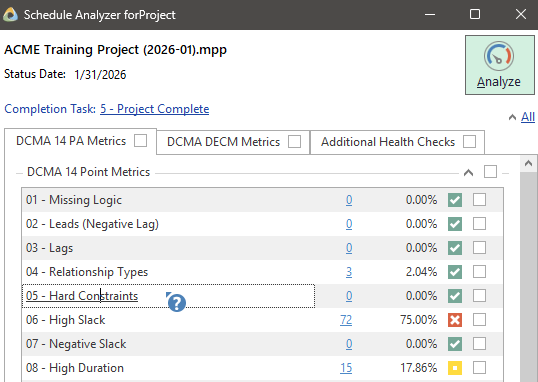
17 of the schedule metrics from the DCMA EVMS Compliance Metrics (DECM), such as dangling starts and finishes, out-of-sequence progress and invalid dates, each shown with its DECM ID.
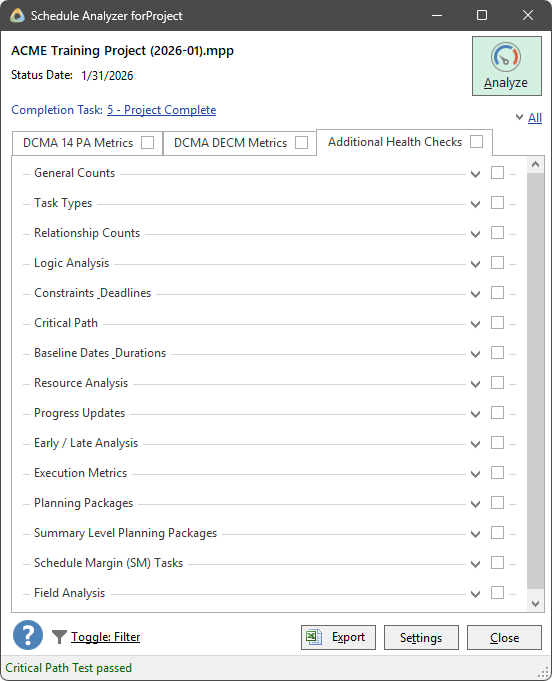
Over 150 additional health checks
Industry best-practice checks in 15 groups:
- General Counts
- Task Types
- Relationship Counts
- Logic Analysis
- Constraints & Deadlines
- Critical Path
- Baseline Dates & Durations
- Resource Analysis
- Progress Updates
- Early / Late Analysis
- Execution Metrics
- Planning Packages
- Summary Level Planning Packages
- Schedule Margin (SM) Tasks
- Field Analysis
Red, yellow and green markers point you to what needs a closer look. They’re a flag for discussion, not a pass/fail grade. Browse the full metric list.
Every metric explained
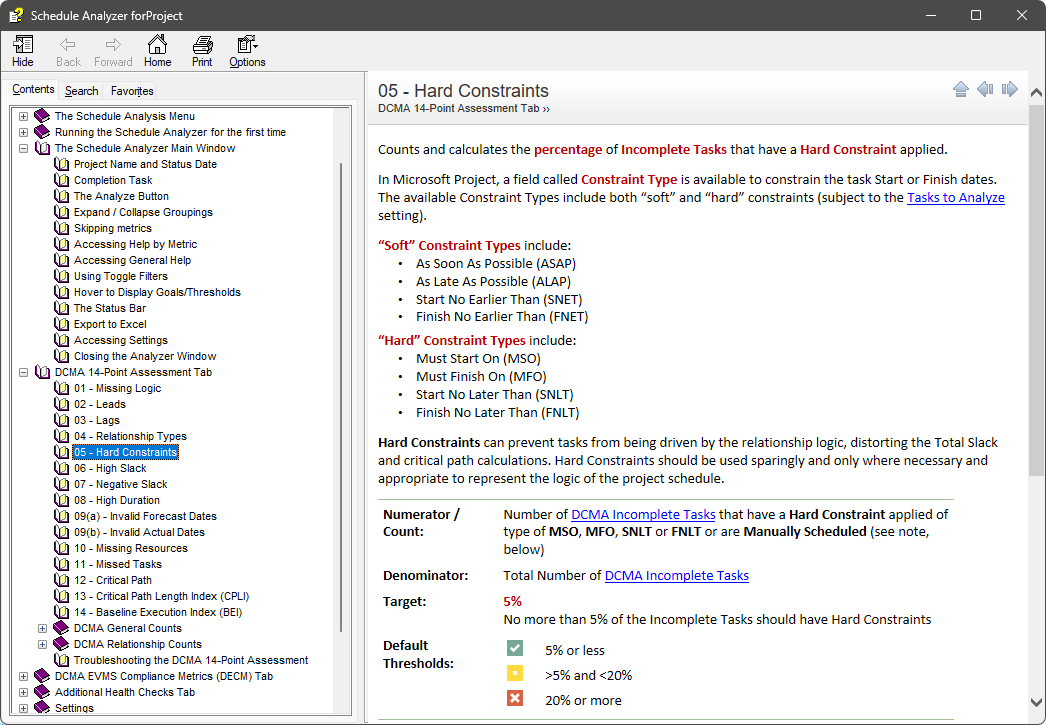
Over 300 pages of built-in help cover every metric and setting. Click any metric name to open its help topic: what it counts, the numerator and denominator, the target and the default thresholds. You can see exactly how each result is calculated.
Set it up your way
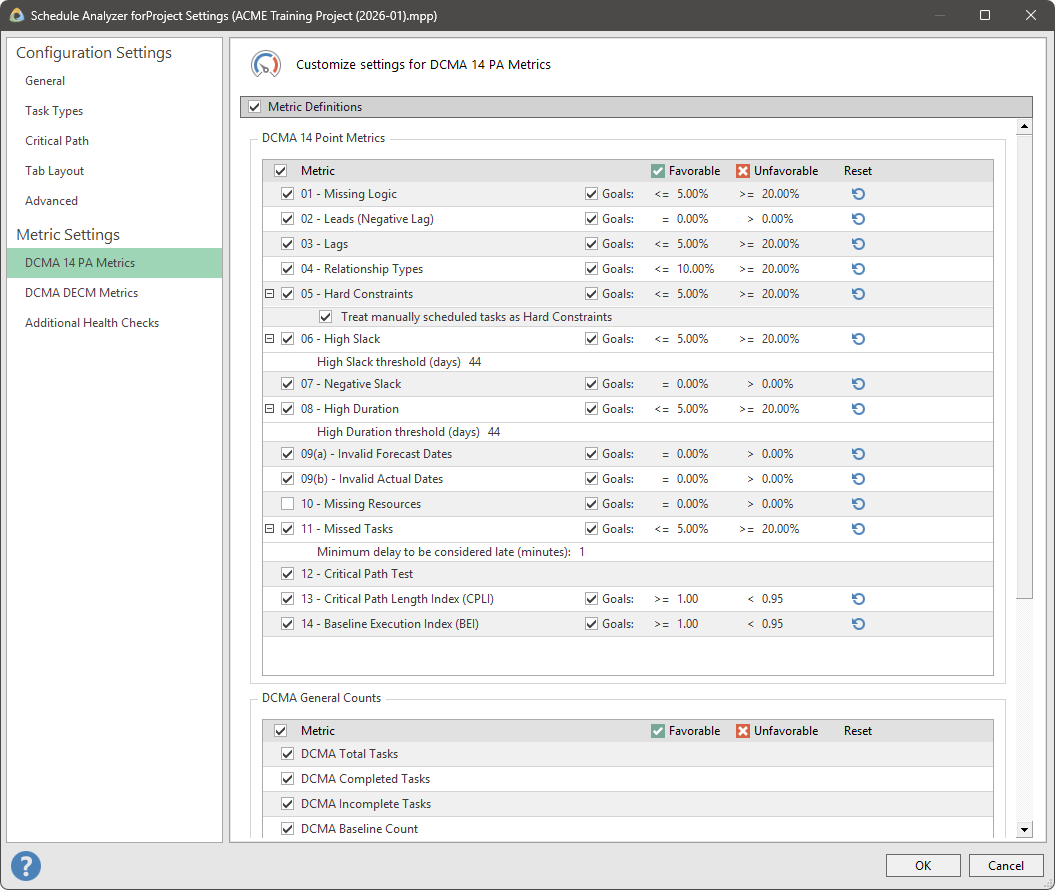
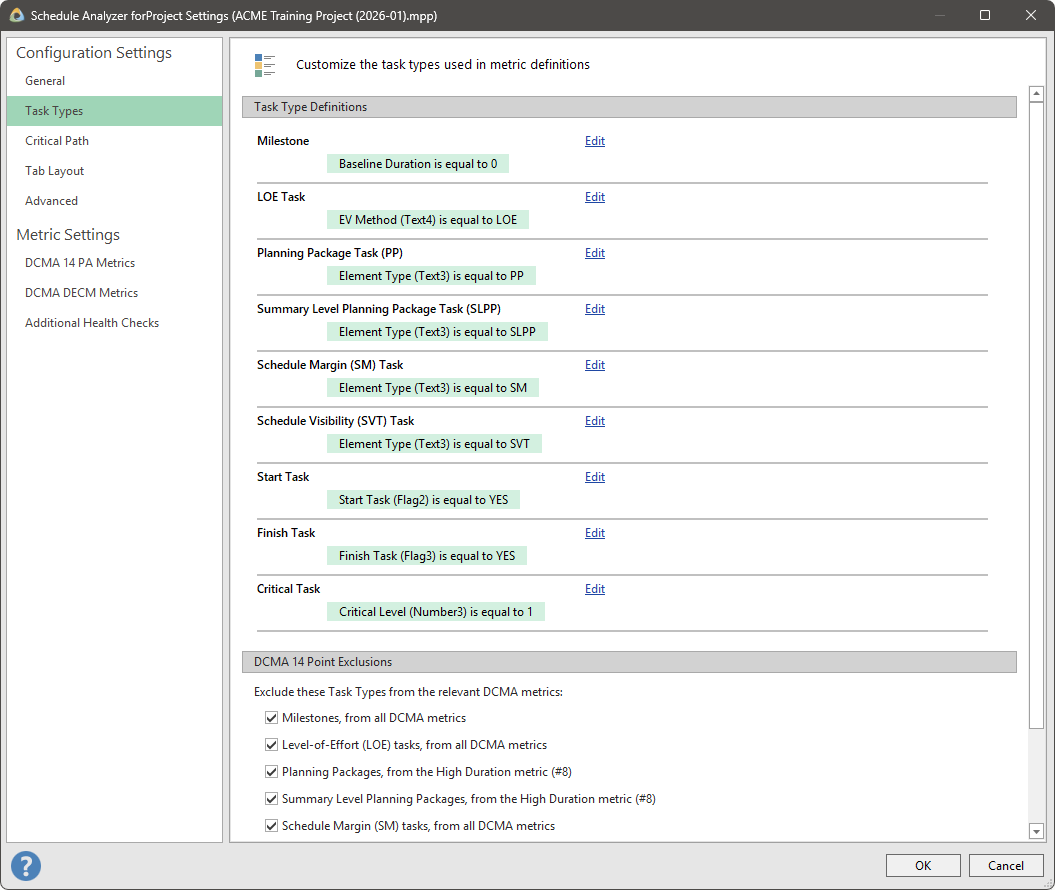
Every metric, threshold and task type can be tuned to match how your organization builds and reviews schedules.
- Turn any metric on or off, and set its favorable and unfavorable goals.
- Adjust metric parameters, such as the 44-day High Slack and High Duration thresholds.
- Define each task type (milestone, LOE, planning package, SLPP, schedule margin, SVT and more) with a rule on a Microsoft Project field you already use.
- Exclude milestones, LOE and schedule margin tasks from the DCMA metrics, and planning packages, SLPPs and SVTs where they apply.
- Build your own tabs, rename metrics and arrange them however your team works, then save the layout to share it.
Find it, fix it, check again
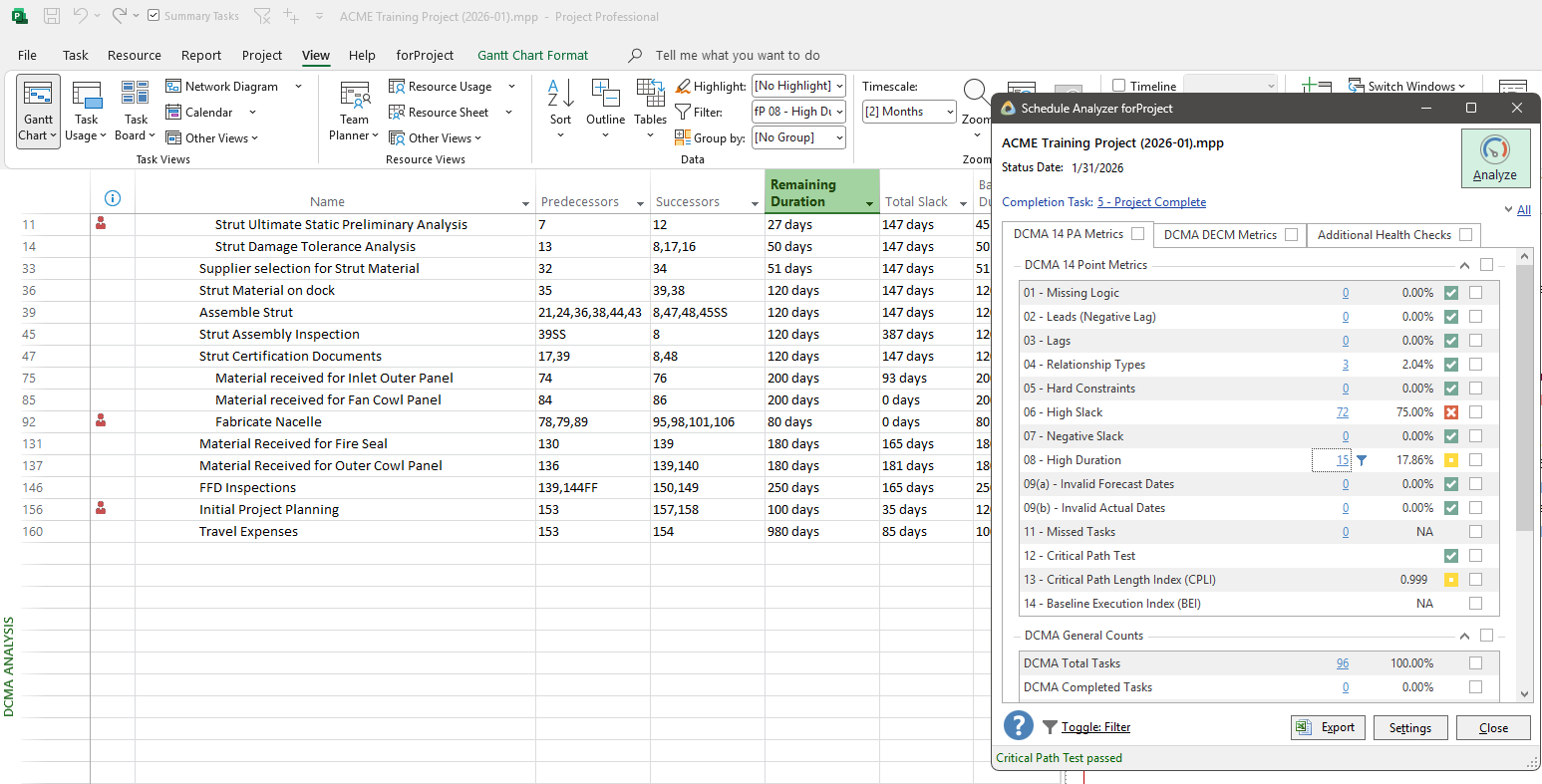
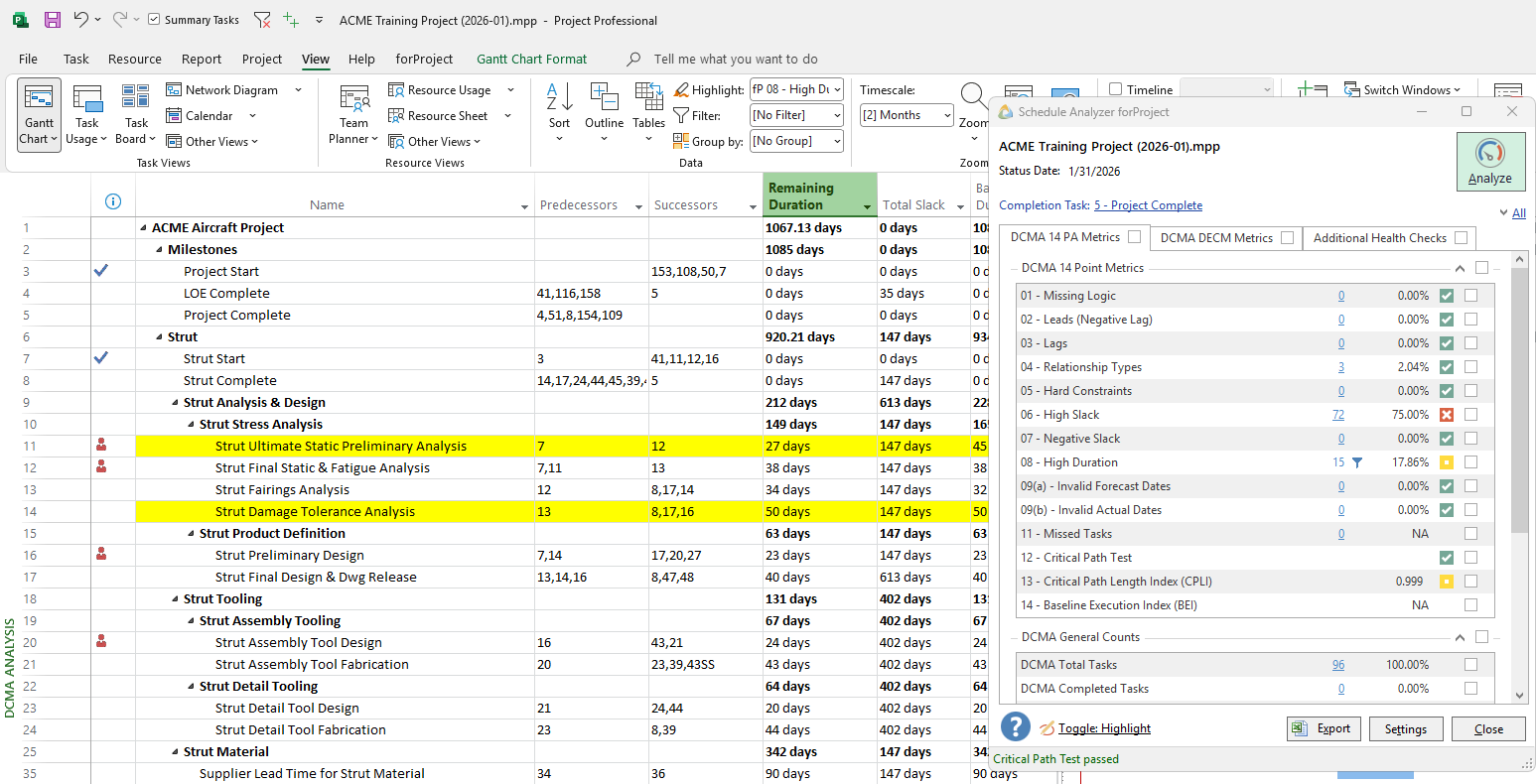
Click any count to filter Microsoft Project down to the tasks behind it, or highlight them in the full schedule. Fix them, click Analyze again, and watch the markers change.
Then deliver it in the format your customer requires
Once the schedule is clean, export it straight from Microsoft Project for your CDRL submission.
IPMDAR and IPMR exporters, built in
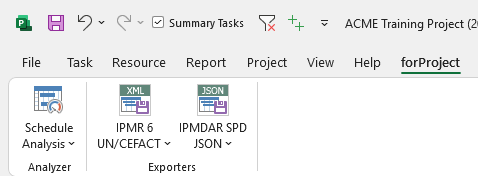
From the forProject tab in Microsoft Project, export the IPMDAR Schedule Performance Dataset (SPD) in JSON, or IPMR Format 6 in UN/CEFACT XML, ready to submit to your customer.
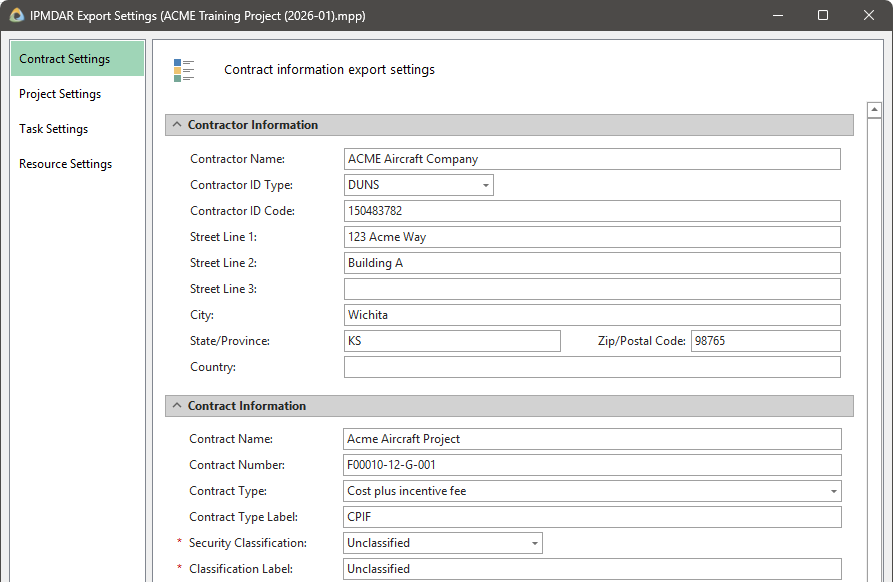
Both exporters are highly configurable, so each file meets the requirements of its format and your contract: contractor and contract information, plus project, task and resource settings.
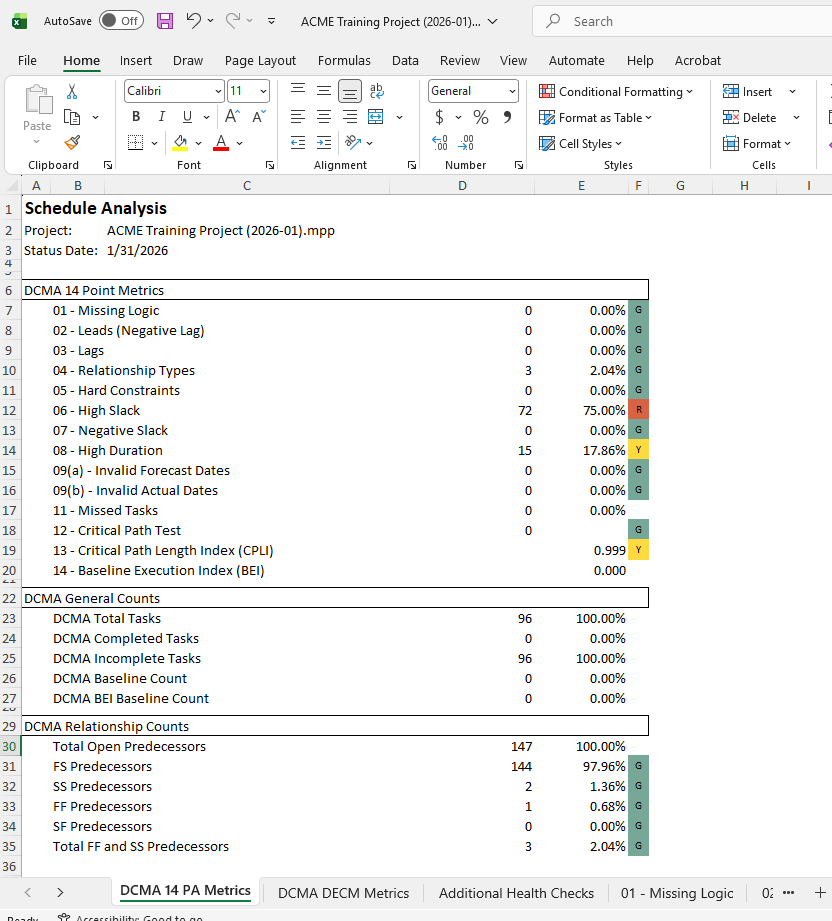
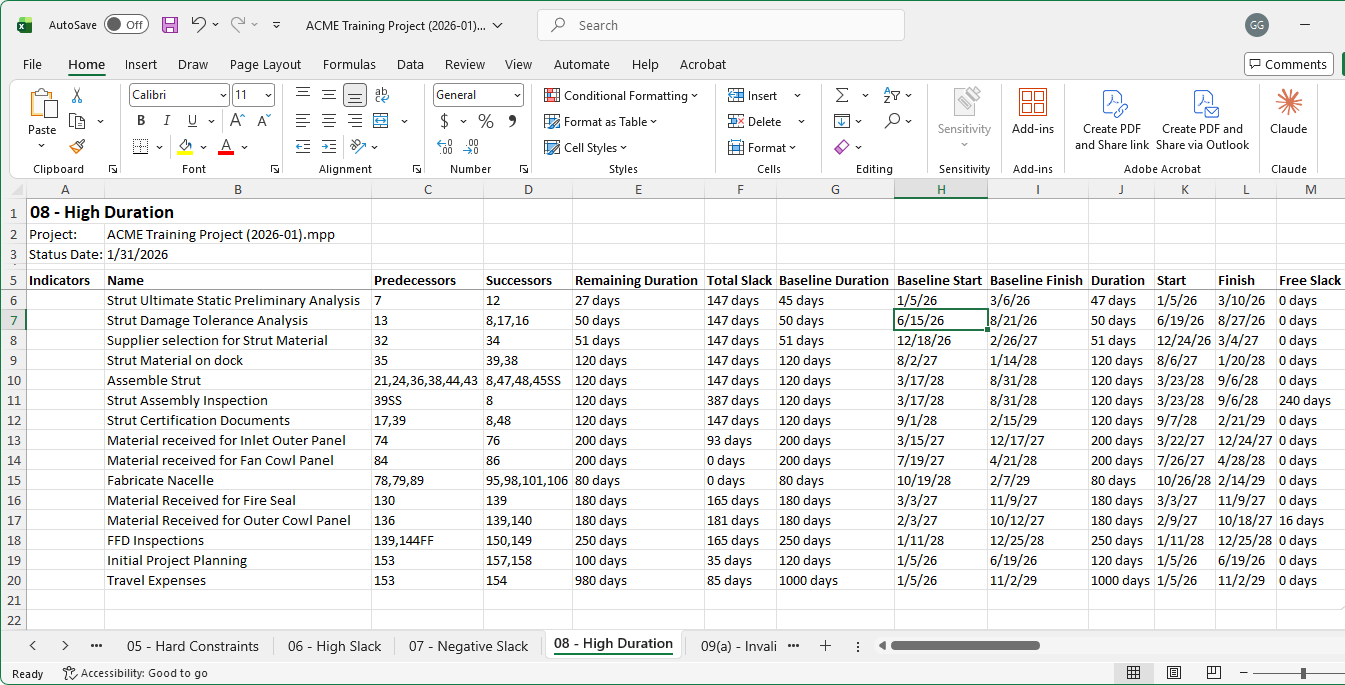
Share the results in Excel
- A summary sheet, plus a sheet listing the tasks behind each metric.
- Share results with stakeholders and keep a record of schedule health from one status date to the next.
Better schedules, better earned value
Earned value is only as good as the schedule underneath it. Schedule Analyzer forProject helps EVMS forProject customers keep their schedules clean, so the performance numbers built on them hold up.
Frequently asked questions
What software runs the DCMA 14-Point Assessment in Microsoft Project?
Schedule Analyzer forProject is a Microsoft Project add-in that runs the full DCMA 14-Point Assessment, the 17 DCMA DECM schedule metrics and 150+ other schedule health checks inside Microsoft Project. It shows the tasks behind each result so you can fix them and check again, then exports IPMDAR SPD or IPMR Format 6 files.
Is there a free trial?
Yes. Schedule Analyzer forProject has a free 30-day trial. Request it and we’ll send you a download link, so you can analyze your own schedule.
Which versions of Microsoft Project does it work with?
Any version of Microsoft Project that Microsoft currently supports, Standard or Professional.
Does it work with Primavera P6?
No. Schedule Analyzer forProject works with Microsoft Project only. For earned value on Primavera P6 schedules, see EVMS forProject.
Are the DCMA metrics pass/fail?
No. DCMA has said that tripping a red threshold is a flag for further discussion and investigation, not a failure. Schedule Analyzer forProject uses red, yellow and green markers to point you to what needs a closer look.
Can I exclude LOE and schedule margin tasks?
Yes. In Settings › Task Types you can exclude milestones, LOE and schedule margin tasks from all DCMA metrics, and planning packages, SLPPs and SVTs from the metrics where they apply.
Can it export the IPMDAR Schedule Performance Dataset?
Yes. Schedule Analyzer forProject exports the IPMDAR Schedule Performance Dataset (SPD) in JSON, and IPMR Format 6 in UN/CEFACT XML, right from Microsoft Project. Both exporters are highly configurable to meet the requirements of each format.
Is there a DCMA 14-Point Assessment reference?
Yes. Our free DCMA 14-Point Assessment checklist lists each check with its threshold.
Try it on your own schedule
Download a free 30-day trial, or let us walk you through it in a live demo.
Questions about pricing or features? Send us an inquiry · Download the brochure