
The DCMA 14-Point Assessment is a set of 14 checks for the quality of an integrated master schedule (IMS). This free one-page checklist shows each check, how it’s calculated, and its green, yellow and red thresholds, based on DCMA’s own guidance. Each term links to its definition in the forProject Encyclopedia.
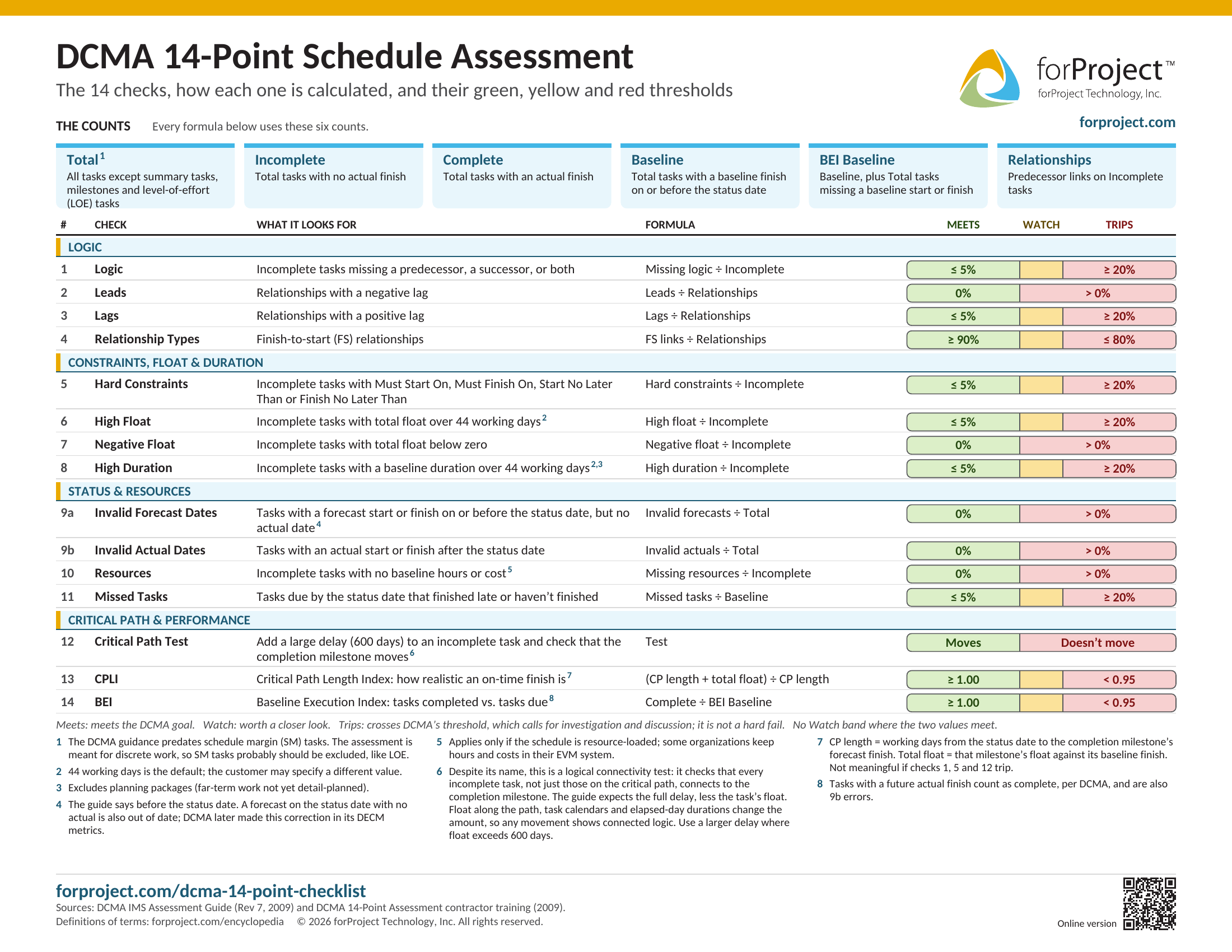
Free download: DCMA 14-Point Assessment Checklist (PDF, one page). It prints clearly in color or black and white.
What Is the DCMA 14-Point Assessment?
The DCMA 14-Point Assessment is a set of 14 tests from the Defense Contract Management Agency (DCMA) for judging the quality of an integrated master schedule. Each test counts the tasks or links that break a basic scheduling practice and compares that count with a threshold.
The checks fall into four groups, the same ones used in the tables below: logic; constraints, float and duration; status and resources; and critical path and performance.
DCMA now uses its DECM metrics for EVMS reviews. The 14-Point Assessment is still widely used for quick checks of schedule health.
The Six Counts
Every formula below uses these six counts.
| Total | All tasks except summary tasks, milestones and level-of-effort (LOE) tasks.1 |
| Incomplete | Total tasks with no actual finish. |
| Complete | Total tasks with an actual finish. |
| Baseline | Total tasks with a baseline finish on or before the status date. |
| BEI Baseline | Baseline, plus Total tasks missing a baseline start or finish. |
| Relationships | Predecessor links on Incomplete tasks. |
How to Read the Thresholds
Meets meets the DCMA goal. Results between the two values are Watch (yellow): worth a closer look. Trips crosses DCMA’s threshold, which calls for investigation and discussion; it is not a hard fail. Checks with no Watch band, such as Leads, go straight from Meets to Trips.
Logic
| # | Check | What it looks for | Formula | Meets | Trips |
|---|---|---|---|---|---|
| 1 | Logic | Incomplete tasks missing a predecessor, a successor, or both | Missing logic ÷ Incomplete | ≤ 5% | ≥ 20% |
| 2 | Leads | Relationships with a negative lag | Leads ÷ Relationships | 0% | > 0% |
| 3 | Lags | Relationships with a positive lag | Lags ÷ Relationships | ≤ 5% | ≥ 20% |
| 4 | Relationship Types | Finish-to-start (FS) relationships | FS links ÷ Relationships | ≥ 90% | ≤ 80% |
Constraints, Float & Duration
| # | Check | What it looks for | Formula | Meets | Trips |
|---|---|---|---|---|---|
| 5 | Hard Constraints | Incomplete tasks with Must Start On, Must Finish On, Start No Later Than or Finish No Later Than | Hard constraints ÷ Incomplete | ≤ 5% | ≥ 20% |
| 6 | High Float | Incomplete tasks with total float over 44 working days2 | High float ÷ Incomplete | ≤ 5% | ≥ 20% |
| 7 | Negative Float | Incomplete tasks with total float below zero | Negative float ÷ Incomplete | 0% | > 0% |
| 8 | High Duration | Incomplete tasks with a baseline duration over 44 working days2, 3 | High duration ÷ Incomplete | ≤ 5% | ≥ 20% |
Status & Resources
| # | Check | What it looks for | Formula | Meets | Trips |
|---|---|---|---|---|---|
| 9a | Invalid Forecast Dates | Tasks with a forecast start or finish on or before the status date, but no actual date4 | Invalid forecasts ÷ Total | 0% | > 0% |
| 9b | Invalid Actual Dates | Tasks with an actual start or finish after the status date | Invalid actuals ÷ Total | 0% | > 0% |
| 10 | Resources | Incomplete tasks with no baseline hours or cost5 | Missing resources ÷ Incomplete | 0% | > 0% |
| 11 | Missed Tasks | Tasks due by the status date that finished late or haven’t finished | Missed tasks ÷ Baseline | ≤ 5% | ≥ 20% |
Critical Path & Performance
| # | Check | What it looks for | Formula | Meets | Trips |
|---|---|---|---|---|---|
| 12 | Critical Path Test | Add a large delay (600 days) to an incomplete task and check that the completion milestone moves6 | Test | Moves | Doesn’t move |
| 13 | CPLI | Critical Path Length Index: how realistic an on-time finish is7 | (CP length + total float) ÷ CP length | ≥ 1.00 | < 0.95 |
| 14 | BEI | Baseline Execution Index: tasks completed vs. tasks due8 | Complete ÷ BEI Baseline | ≥ 1.00 | < 0.95 |
Notes
- The DCMA guidance predates the common use of schedule margin (SM) tasks and doesn’t address them. Because the 14-Point Assessment is meant for discrete work, meaning tasks that represent real work or cost in the performance measurement baseline, SM tasks probably should be excluded for the same reason LOE is.
- 44 working days is the default; the guide says the customer may specify a different value.
- High Duration excludes planning packages (far-term work that hasn’t been detail-planned yet).
- The 14-Point Assessment guide flags forecast dates before the status date. A forecast dated on the status date with no actual is also out of date, so this checklist uses on or before. DCMA later made the same correction in its DECM metrics but never updated the 14-Point Assessment documents.
- Resources applies only if the schedule is resource-loaded. Some organizations keep hours and costs in their EVM system instead.
- Despite its name, this is a logical connectivity test: it checks that every incomplete task, not just those on the critical path, connects to the completion milestone. The DCMA guide expects the completion date to slip by the full delay, less the tested task’s float. In practice, float elsewhere on the path, differing task calendars and elapsed-day durations can change the amount, so any detectable movement in the completion milestone shows the logic is connected. If the path runs through float greater than 600 days, use a larger delay.
- Critical path length is the working days from the status date to the completion milestone’s forecast finish. Total float is the completion milestone’s float measured against its baseline finish date. If Logic (1) and Hard Constraints (5) are well into red, the Critical Path Test will likely trip too, and CPLI isn’t meaningful.
- Tasks count as complete even if their actual finish is after the status date, as DCMA instructs. That also makes them a 9b error.
Frequently Asked Questions
What is the DCMA 14-Point Assessment?
A set of 14 checks DCMA developed to test the quality of an integrated master schedule (IMS): its logic, constraints, float, durations, status, resources and critical path. For the full definition, see DCMA 14-Point Assessment in the forProject Encyclopedia.
What are the DCMA 14-Point Assessment thresholds?
Most percentage checks meet the goal at 5% or less and trip at 20% or more. Leads, negative float, invalid dates and missing resources should be zero. At least 90% of relationships should be finish-to-start. CPLI and BEI should be 1.00 or higher, and trip below 0.95. The table above lists every threshold.
Is the 14-Point Assessment pass/fail?
No. DCMA has said these metrics are not pass/fail. A check that trips its threshold calls for investigation and discussion with the scheduler; it is not a hard fail. That is why this checklist uses Meets, Watch and Trips.
Should schedule margin tasks be included?
The DCMA guidance doesn’t address them, because schedule margin wasn’t common when it was written. Since the assessment is meant for discrete work, schedule margin tasks probably should be excluded, like level-of-effort tasks.
Why 44 working days?
44 working days is about two months, DCMA’s default for both High Float and High Duration. The guide allows the customer to specify a different value.
Is the 14-Point Assessment still used?
Yes. DCMA has since moved to its DECM metrics, but the 14-Point Assessment was widely used for about ten years and remains a common standard for schedule quality, inside and outside DCMA reviews.
Sources: DCMA IMS Assessment Guide (Rev 7, 2009) and DCMA 14-Point Assessment contractor training (2009).
More free references: EVM & Scheduling Job Aids.