
DCMA’s EVMS Compliance Metrics (DECM) include 17 schedule checks you can calculate from the integrated master schedule (IMS) itself. This free two-page job aid shows each check, how it’s calculated and its threshold, based on DCMA’s DECM v8.1 metric specifications. Each term links to its definition in the forProject Encyclopedia.
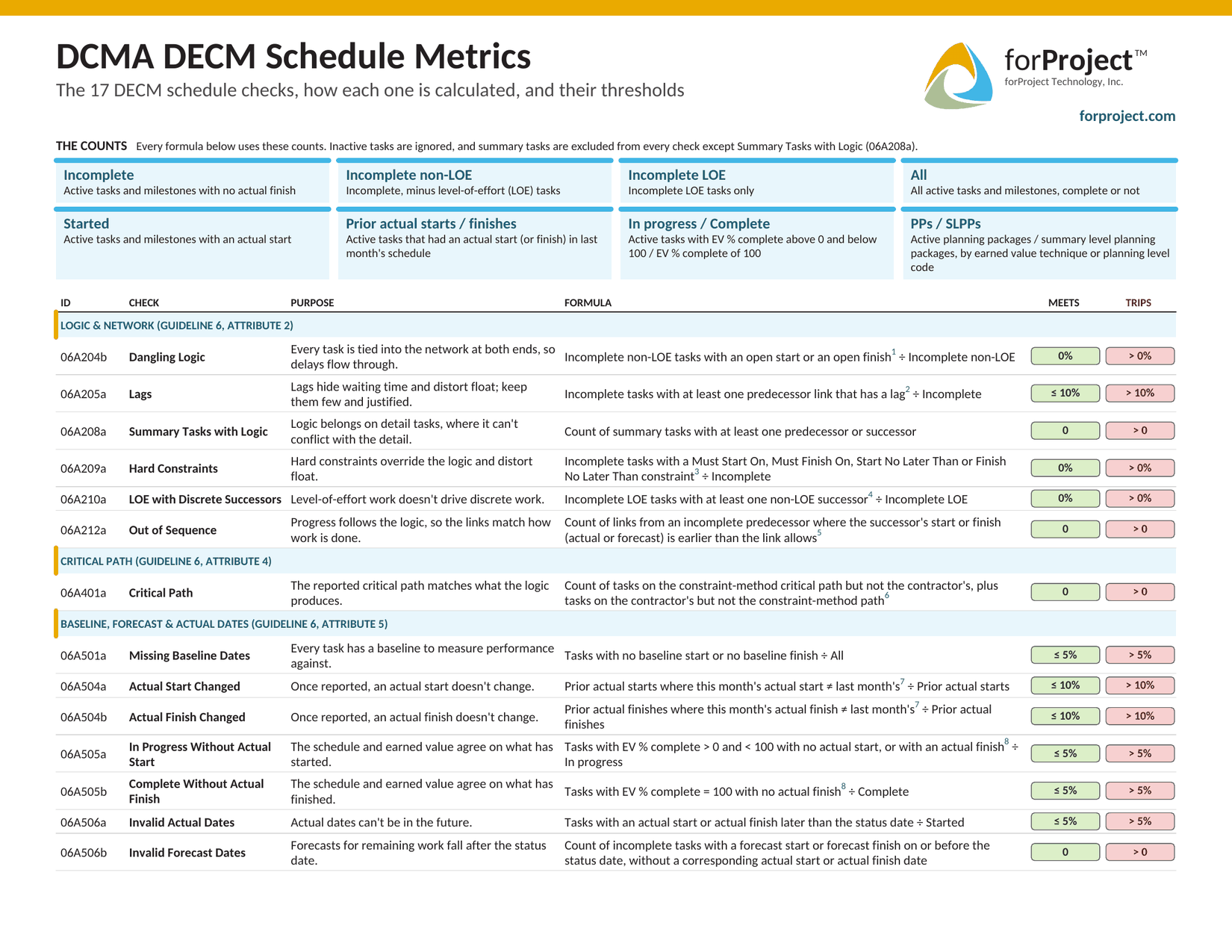
Free download: DCMA DECM Schedule Metrics (PDF, two pages). It prints clearly in color or black and white.
The Counts
Every formula below uses these counts. Inactive tasks are ignored, and summary tasks are excluded from every check except Summary Tasks with Logic (06A208a).
| Incomplete | Active tasks and milestones with no actual finish. |
| Incomplete non-LOE | Incomplete, minus level-of-effort (LOE) tasks. |
| Incomplete LOE | Incomplete LOE tasks only. |
| All | All active tasks and milestones, complete or not. |
| Started | Active tasks and milestones with an actual start. |
| Prior actual starts / finishes | Active tasks that had an actual start (or finish) in last month’s schedule. |
| In progress / Complete | Active tasks with EV % complete above 0 and below 100 / EV % complete of 100. |
| PPs / SLPPs | Planning packages / summary level planning packages, identified by earned value technique or planning level code. |
How to Read the Thresholds
Meets is within DCMA’s threshold. Trips crosses it, which calls for a closer look and discussion with the scheduler; it is not a hard fail. DECM sets one threshold per check, so there is no Watch band between the two.
Logic & Network (Guideline 6, Attribute 2)
| ID | Check | Purpose | Formula | Meets | Trips |
|---|---|---|---|---|---|
| 06A204b | Dangling Logic | Every task is tied into the network at both ends, so delays flow through. | Incomplete non-LOE tasks with an open start or an open finish1 ÷ Incomplete non-LOE | 0% | > 0% |
| 06A205a | Lags | Lags hide waiting time and distort float; keep them few and justified. | Incomplete tasks with at least one predecessor link that has a lag2 ÷ Incomplete | ≤ 10% | > 10% |
| 06A208a | Summary Tasks with Logic | Logic belongs on detail tasks, where it can’t conflict with the detail. | Count of summary tasks with at least one predecessor or successor | 0 | > 0 |
| 06A209a | Hard Constraints | Hard constraints override the logic and distort float. | Incomplete tasks with a Must Start On, Must Finish On, Start No Later Than or Finish No Later Than constraint3 ÷ Incomplete | 0% | > 0% |
| 06A210a | LOE with Discrete Successors | Level-of-effort work doesn’t drive discrete work. | Incomplete LOE tasks with at least one non-LOE successor4 ÷ Incomplete LOE | 0% | > 0% |
| 06A212a | Out of Sequence | Progress follows the logic, so the links match how work is done. | Count of links from an incomplete predecessor where the successor’s start or finish (actual or forecast) is earlier than the link allows5 | 0 | > 0 |
Critical Path (Guideline 6, Attribute 4)
| ID | Check | Purpose | Formula | Meets | Trips |
|---|---|---|---|---|---|
| 06A401a | Critical Path | The reported critical path matches what the logic produces. | Count of tasks on the constraint-method critical path but not the contractor’s, plus tasks on the contractor’s but not the constraint-method path6 | 0 | > 0 |
Baseline, Forecast & Actual Dates (Guideline 6, Attribute 5)
| ID | Check | Purpose | Formula | Meets | Trips |
|---|---|---|---|---|---|
| 06A501a | Missing Baseline Dates | Every task has a baseline to measure performance against. | Tasks with no baseline start or no baseline finish ÷ All | ≤ 5% | > 5% |
| 06A504a | Actual Start Changed | Once reported, an actual start doesn’t change. | Prior actual starts where this month’s actual start ≠ last month’s7 ÷ Prior actual starts | ≤ 10% | > 10% |
| 06A504b | Actual Finish Changed | Once reported, an actual finish doesn’t change. | Prior actual finishes where this month’s actual finish ≠ last month’s7 ÷ Prior actual finishes | ≤ 10% | > 10% |
| 06A505a | In Progress Without Actual Start | The schedule and earned value agree on what has started. | Tasks with EV % complete > 0 and < 100 with no actual start, or with an actual finish8 ÷ In progress | ≤ 5% | > 5% |
| 06A505b | Complete Without Actual Finish | The schedule and earned value agree on what has finished. | Tasks with EV % complete = 100 with no actual finish8 ÷ Complete | ≤ 5% | > 5% |
| 06A506a | Invalid Actual Dates | Actual dates can’t be in the future. | Tasks with an actual start or actual finish later than the status date ÷ Started | ≤ 5% | > 5% |
| 06A506b | Invalid Forecast Dates | Forecasts for remaining work fall after the status date. | Count of incomplete tasks with a forecast start or forecast finish on or before the status date, without a corresponding actual start or actual finish date | 0 | > 0 |
| 06A506c | Forecast Riding the Status Date | Forecasts show when the work is really expected to happen. | Incomplete tasks with a forecast start within 3 working days after the status date both this month and last, or (started by last month’s status date) a remaining duration within ±2 working days of last month’s7, 9 ÷ Incomplete | ≤ 1% | > 1% |
Planning Packages (Guidelines 8 and 10)
| ID | Check | Purpose | Formula | Meets | Trips |
|---|---|---|---|---|---|
| 08I101a | SLPP with Short Duration | SLPPs represent high-level, far-term work; a very short duration means the SLPP hasn’t been planned properly. | Summary level planning packages with a baseline duration ≤ 1 day ÷ SLPPs | ≤ 10% | > 10% |
| 10A303a | PP with Short Duration | PPs represent far-term work within a control account or SLPP; a very short duration means the PP hasn’t been planned properly. | Planning packages with a baseline duration ≤ 1 day ÷ PPs | ≤ 10% | > 10% |
Notes
- Open start: a task whose only predecessor links are finish-to-finish or start-to-finish, or that has none; a milestone with no predecessor. Open finish: a task whose only successor links are start-to-start or start-to-finish, or that has none; a milestone with no successor. The first task (earliest baseline start) is exempt from the open-start test, and the last (latest baseline finish) from the open-finish test.
- Leads (negative lags) are also reviewed under Out of Sequence (06A212a), since many leads cause out-of-sequence conditions. If Lags trips, DCMA asks for the rationale behind them.
- Other tools: Primavera’s Mandatory Start and Mandatory Finish; Open Plan’s Start Fixed Target and Finish Fixed Target. In Microsoft Project, a manually scheduled task behaves like Must Start On, so many analysts count it too.
- An LOE task is not counted if its only successors are end-item deliverables or contract completion.
- By link type, where P is the incomplete predecessor: finish-to-start, successor start before P’s forecast finish; start-to-start, successor start before P’s forecast start; finish-to-finish, successor finish before P’s forecast finish; start-to-finish, successor finish before P’s forecast start. This counts links, not tasks.
- Constraint method: put a hard constraint on the program completion milestone, dated well before its baseline finish (600 working days is a common choice), so float goes negative along every connected path. The tasks with the most negative float are the critical path. DCMA lists this test as manual because the contractor’s critical path has to be identified; once it’s flagged in a field, the comparison can be automated.
- Needs last month’s values for the same tasks, matched by unique ID. Prior-period dates must be kept or imported before the analysis.
- EV % complete comes from the schedule if it carries the field, otherwise from the EV cost tool.
- Riding start applies to tasks not yet started; riding finish to tasks started by last month’s status date. A task is counted once even if both apply.
Frequently Asked Questions
What is DECM?
DCMA EVMS Compliance Metrics: the data-driven tests the Defense Contract Management Agency (DCMA) uses to assess a contractor’s earned value management system against the 32 guidelines of EIA-748. Most of the schedule tests fall under Guideline 6. For the full definition, see DCMA EVMS Compliance Metrics (DECM) in the forProject Encyclopedia.
How is DECM different from the 14-Point Assessment?
DECM replaced the 14-Point Assessment in DCMA reviews. It adds checks on level-of-effort logic, summary-task logic, out-of-sequence progress, changed actual dates and forecasts riding the status date, and it compares this month’s schedule with last month’s. Each check has a single threshold. See our DCMA 14-Point Assessment checklist for the older set.
Are the DECM metrics pass/fail?
No. DCMA’s instructions say to use each result as an indicator in the overall risk assessment to decide whether further evaluation is warranted. That is why this job aid uses Meets and Trips.
Do I need last month’s schedule?
Yes, for three checks: Actual Start Changed (06A504a), Actual Finish Changed (06A504b) and Forecast Riding the Status Date (06A506c). They compare each task’s dates with the previous month’s values.
Sources: DCMA DECM Metric Specifications, v8.1 (February 2026), and DCMA EVMS Metrics Tracking and Data Artifact List, v8.1, both on DCMA’s Earned Value Management Systems page.
More free references: EVM & Scheduling Job Aids.