
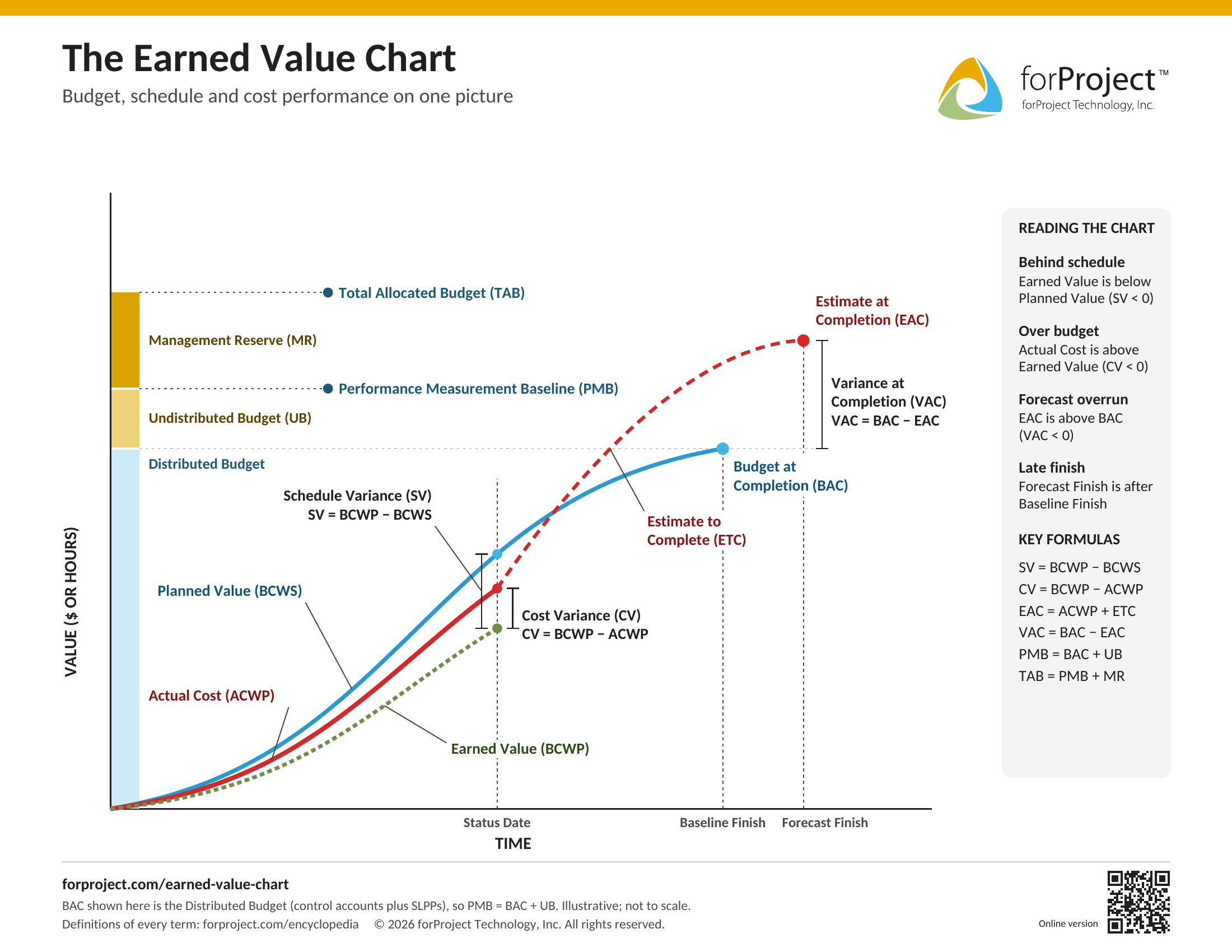
The classic earned value picture: budget, schedule and cost performance on one chart. It shows how the budget is built up, how planned value, earned value and actual cost compare at the status date, and what the forecast says about the finish. Each term links to its full definition in the forProject Encyclopedia.
Free download: Download the one-page PDF (US Letter, landscape). Free to print for training and reference.
How the Budget Stacks Up
| Distributed Budget | Budget assigned to control accounts and summary level planning packages (SLPPs). On this chart it equals BAC. |
| Undistributed Budget (UB) | Budget for authorized work not yet assigned to a control account. |
| Performance Measurement Baseline (PMB) | PMB = BAC + UB |
| Management Reserve (MR) | Budget held back for unknowns within the scope of the work. It is not part of the PMB. |
| Total Allocated Budget (TAB) | TAB = PMB + MR |
The Three Curves
| Planned Value (BCWS) | The time-phased budget: what you planned to accomplish by each date. It ends at BAC on the baseline finish. |
| Earned Value (BCWP) | The budgeted value of the work actually done. |
| Actual Cost (ACWP) | What the work actually done has cost. |
Variances and Forecasts
| Schedule Variance (SV) | SV = BCWP − BCWS. Negative means behind schedule. |
| Cost Variance (CV) | CV = BCWP − ACWP. Negative means over budget. |
| Estimate to Complete (ETC) | The forecast cost of the remaining work. |
| Estimate at Completion (EAC) | EAC = ACWP + ETC |
| Variance at Completion (VAC) | VAC = BAC − EAC. Negative means a forecast overrun. |
BAC shown here is the Distributed Budget (control accounts plus SLPPs), so PMB = BAC + UB. The chart is illustrative and not to scale. For every formula on one page, see EVM Formulas; for how contract price, cost and budget fit together, see Contract Budget Relationships. More free tools are on Job Aids.
Test what you know: try our free Earned Value Practice Questions, 10 questions with explanations and results by topic.